
Finding enough room for a dining table can be difficult when you live in a small apartment, compact house, studio, or home with an open-plan layout. A table that looks perfectly comfortable on an ordinary day can suddenly feel oversized when chairs are pulled out and people need to move around it.
That is where an extendable dining table for a small space can make a real difference.
Instead of dedicating valuable floor space to a large table all the time, an extendable design can stay compact for everyday meals and expand when you need additional seating. You might use it as a small two- or four-person table during the week, then extend it for a family dinner, holiday meal, or gathering with friends.
However, not every extendable table is suitable for a small room. The closed dimensions, extended dimensions, table shape, chair size, extension mechanism, and surrounding traffic all matter.
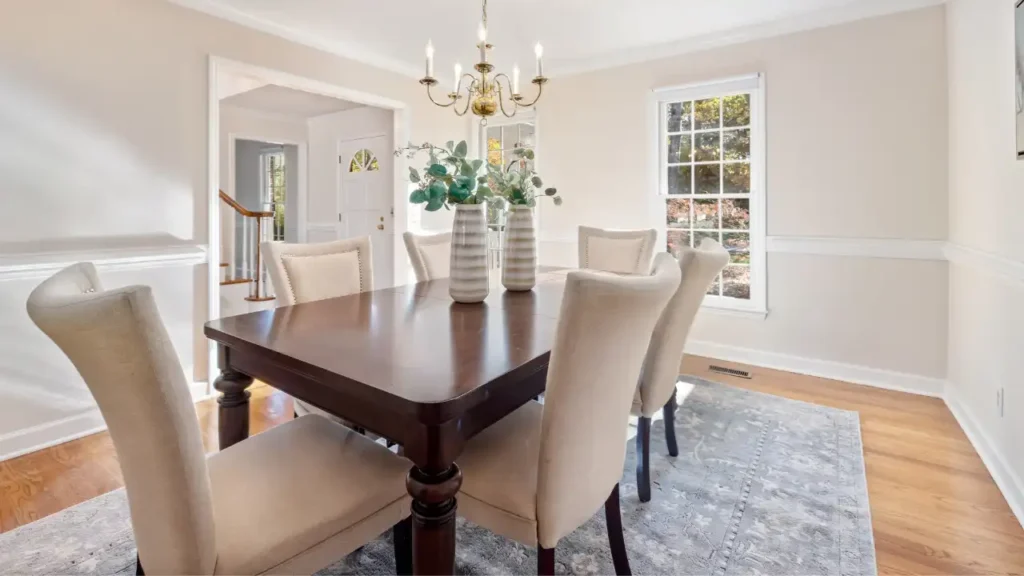
This guide covers the best extendable dining table ideas for small spaces, including round, rectangular, oval, drop-leaf, butterfly-leaf, minimalist, wood, and multifunctional designs. You will also learn how to measure your room, choose the right shape, plan seating, compare extension mechanisms, and avoid common buying mistakes.
What Is an Extendable Dining Table?
An extendable dining table is designed to change size when additional dining or working space is needed. In its compact configuration, it takes up less room. When guests arrive, the tabletop can be expanded using an integrated or separate extension system.
The basic idea is simple: use only as much table as you need most of the time.
Different designs use different mechanisms. Some tables split apart so an additional leaf can be inserted, while others have folding sections or built-in extension leaves.
How an Extendable Dining Table Works
Common extension systems include:
- Removable leaves
- Butterfly leaves
- Drop-leaf sections
- Sliding extension systems
- Self-storing leaves
- Foldable or gate-leg designs
Each mechanism has different advantages. A drop-leaf table, for example, can be extremely compact when folded, while a butterfly-leaf table can provide convenient expansion without requiring a separate place to store the leaf.
Before buying, look at both the closed and extended configurations. A table may be ideal when closed but difficult to use once fully extended.
Why Extendable Tables Work Well in Small Homes
The biggest advantage is flexibility.
In compact mode, the table can support:
- Breakfast
- Everyday dinners
- Coffee
- Homework
- Laptop work
- Crafts
- Small gatherings
When extended, the same table can accommodate:
- Family meals
- Dinner parties
- Holidays
- Guests
- Larger projects
- Entertaining
This flexibility can be particularly useful when the dining area also serves another purpose.
15 Best Extendable Dining Table Ideas for Small Spaces
The best design depends on the shape of your room, your usual number of diners, and how often you need additional space. Here are 15 practical options to consider.
1. Compact Rectangular Extendable Dining Table
A compact rectangular table is one of the most versatile choices for a small dining room.
Its straight shape can work particularly well in narrow rooms because you can position one side near a wall when the table is being used in its smallest configuration. When guests arrive, it can be pulled away from the wall and extended.
This style is best suited to:
- Small dining rooms
- Apartments
- Narrow dining areas
- Open-plan homes
Look for a relatively slim tabletop and a base that does not interfere with seating. If you regularly seat four people but occasionally need six, choose a model that is comfortable in its everyday configuration rather than buying a permanently large table.
2. Small Round Extendable Dining Table
A small round extendable dining table can be an excellent choice for a compact square room.
The lack of sharp corners creates a softer visual profile and can make movement around the table feel more natural. Round tables can also make conversations comfortable because diners face one another more directly.
They work especially well in:
- Small kitchens
- Square dining areas
- Breakfast nooks
- Compact apartments
The tradeoff is that a round table may not use wall space as efficiently as a rectangular one. Measure carefully if the table needs to sit close to a wall during everyday use.
3. Oval Extendable Dining Table
An oval table offers a useful middle ground between round and rectangular designs.
Its curved ends soften the appearance of a long tabletop, while the elongated shape can provide more surface area for dining.
An oval extendable table can be a good option when you want:
- Softer edges
- Flexible seating
- A refined appearance
- More tabletop length
- Easier movement around the ends
It is particularly attractive in open-plan interiors where the dining table is visible from the living room.
4. Drop-Leaf Dining Table
A drop-leaf table is one of the most space-conscious dining designs.
Its hinged sections can fold down when you need a smaller footprint. When additional surface area is required, one or both sides can be raised.
This makes drop-leaf tables useful for:
- Studio apartments
- Small kitchens
- Multipurpose rooms
- Very compact dining areas
The main consideration is tabletop stability and the amount of usable surface when the leaves are folded.
5. Butterfly Leaf Extendable Table
A butterfly-leaf table uses a folding extension leaf that is often stored inside the table itself.
This can be especially convenient in a small home because you do not necessarily need a separate cabinet or closet for the extension leaf.
When shopping, check how smoothly the table opens and closes and whether the mechanism feels stable when fully extended.
6. Self-Storing Extendable Dining Table
Self-storing designs are particularly practical when storage space is limited.
Instead of removing the extension leaf and finding somewhere to keep it, the leaf remains within the table or its structure.
This can reduce one of the most annoying problems associated with extendable furniture: remembering where the extra piece is stored.
A self-storing table is worth considering if you frequently switch between compact and extended configurations.
7. Narrow Extendable Dining Table
A narrow extendable table can make excellent use of a long but tight dining area.
Rather than focusing only on length, pay attention to tabletop depth. A slimmer table can preserve more walking space while still providing enough room for everyday dining.
For a narrow room:
- Measure the room width.
- Account for chair depth.
- Identify the main walking route.
- Check appliance and cabinet doors.
- Measure the table both closed and extended.
Avoid choosing a narrow table that is so shallow that plates, serving dishes, and place settings become uncomfortable.
8. Wall-Friendly Extendable Dining Table
Some compact tables are designed to work particularly well near a wall.
This can be useful when you want to keep the table compact during everyday use and move it outward only when guests arrive.
A wall-friendly arrangement can work in:
- Apartment dining nooks
- Kitchen corners
- Small open-plan homes
- Compact breakfast areas
Make sure chairs can still be pulled out comfortably and that the table can actually be moved when you need to extend it.
9. Pedestal Extendable Dining Table
A pedestal base can provide more flexible legroom than a traditional four-leg design.
Instead of having legs at each corner, the central support can leave more freedom for diners to position their chairs.
This can be useful when the table expands to accommodate additional guests.
A pedestal table can also create a cleaner visual appearance, although the stability and construction of the specific design should always be checked.
10. Modern Minimalist Extendable Table
If you want your small dining area to feel clean and uncluttered, consider a minimalist extendable table.
Look for:
- Simple lines
- Slim proportions
- Neutral finishes
- Minimal hardware
- Clean tabletop surfaces
- Uncomplicated bases
A minimalist table does not need to be plain. The quality of the material, proportions, and craftsmanship can provide visual interest without adding unnecessary bulk.
11. Scandinavian Extendable Dining Table
Scandinavian-inspired tables often combine light wood, simple forms, and functional design.
Light oak and other natural-looking finishes can work particularly well in small rooms where you want an airy appearance.
Pair a Scandinavian-style table with:
- Simple dining chairs
- Neutral walls
- Soft textiles
- Natural lighting
- Minimal tabletop decoration
The goal is to create a comfortable dining area without filling every available surface.
12. Wood Extendable Dining Table
Wood remains a versatile choice because it can work with modern, traditional, Scandinavian, farmhouse, and transitional interiors.
Popular wood appearances include:
- Oak
- Walnut
- Ash
- Rubberwood
- Reclaimed wood
Solid wood can offer a warm, substantial appearance, while veneer and engineered wood constructions may provide different combinations of weight, price, and appearance.
Consider your lifestyle before choosing a finish. A dining table used heavily every day may need different maintenance than one used occasionally for entertaining.
13. Glass-Top Extendable Dining Table
Glass can help a compact dining area feel visually lighter because you can see through the tabletop.
This can be useful when the room already contains several pieces of furniture.
However, glass requires regular cleaning and may show fingerprints, crumbs, and smudges more easily than some other surfaces. Consider the table’s construction, edge treatment, and overall durability before choosing one.
14. Multifunctional Extendable Dining Table
A multifunctional table can be particularly useful when one room has several jobs.
During the day, it might serve as:
- A work-from-home desk
- Homework space
- Crafting surface
- Planning area
At mealtimes, it becomes a dining table.
This type of flexibility can be valuable in a studio apartment or small home where separate furniture for every activity is not practical.
15. Convertible Small-Space Dining Table
Convertible tables take flexibility even further by changing configuration depending on the situation.
Some designs can fold, slide, expand, or change their usable footprint.
These tables can be useful for people who need furniture that adapts to changing activities rather than staying in one fixed configuration.
The key is to choose a design that is easy enough to operate that you will actually use its different configurations.
Best Dining Table Shapes for Small Spaces
Table shape can have a surprisingly large effect on how efficiently a compact room works.
| Table Shape | Best For | Main Advantage | Potential Drawback |
|---|---|---|---|
| Round | Square rooms | Soft edges and flexible circulation | Less wall-friendly |
| Oval | Flexible layouts | Curved edges with useful length | Can require more room |
| Rectangular | Narrow rooms | Efficient against walls | Corners need planning |
| Square | Compact square rooms | Balanced footprint | Expansion options vary |
| Drop-leaf | Very small spaces | Highly flexible footprint | Smaller surface when folded |
Round vs. Rectangular Extendable Tables
Choose a round table when the room is compact and relatively square and you want easier movement around the perimeter.
Choose a rectangular table when the room is narrow, when the table needs to sit along a wall, or when you want to make efficient use of a longer room.
Neither shape is automatically better. The room should determine the choice.
Is an Oval Table Better for a Small Dining Room?
An oval table can be a strong choice when you want the softer appearance of a round table but need additional length.
However, an oval table still needs sufficient room around its perimeter. If your dining area is extremely tight, a drop-leaf or compact round table may be more practical.
How to Choose the Right Size Extendable Dining Table
The biggest mistake people make is measuring only the closed table.
You need to understand three different footprints:
- Closed
- Partially extended
- Fully extended
Measure the Room First
Before shopping, measure:
- Room length
- Room width
- Doorways
- Nearby cabinets
- Kitchen islands
- Other furniture
- Walking routes
Draw a simple floor plan if necessary. Mark where doors open and where people normally walk.
Measure the Table in Both Configurations
| Table State | What to Measure |
|---|---|
| Closed | Everyday footprint |
| Partially extended | Occasional seating |
| Fully extended | Maximum seating and circulation |
The extended dimensions are especially important if you plan to use the table for holidays or entertaining.
Don’t Forget Chair Space
The table’s measurements do not represent the entire dining footprint.
You also need to consider:
- Chair width
- Chair depth
- Space needed to pull chairs out
- Walking space behind seated guests
- Nearby furniture
- Door and cabinet movement
A table that technically fits may still make the room uncomfortable if chairs cannot be moved easily.
How Many People Can a Small Extendable Dining Table Seat?
Seating capacity depends on the actual tabletop dimensions, chair width, table legs, and the manufacturer’s design.
As a general planning guide:
| Closed Configuration | Extended Configuration | Approximate Seating |
|---|---|---|
| Compact | Medium | 2–4 |
| Small | Medium-large | 4–6 |
| Medium | Large | 6–8 |
| Narrow | Extended | 4–6 |
These are planning examples rather than universal specifications. Always check the manufacturer’s stated seating capacity and dimensions before purchasing.
If you normally eat as a couple, there may be little reason to keep a large six- or eight-person table open every day. An extendable model allows you to prioritize everyday comfort while retaining extra capacity for occasional guests.
Best Extendable Dining Table Materials
Solid Wood
Solid wood provides a warm, substantial appearance and can work across many interior styles.
Potential advantages include:
- Natural character
- Long service potential with appropriate care
- Repair or refinishing possibilities
- Warm visual texture
Potential considerations include weight, maintenance, and sensitivity to environmental conditions depending on the wood and finish.
Wood Veneer
Wood veneer can provide the appearance of natural wood while allowing manufacturers to use different core materials.
Look beyond the surface appearance and check:
- Core construction
- Veneer quality
- Finish
- Edge treatment
- Extension mechanism
MDF and Engineered Wood
Engineered wood can offer practical construction options at different price points.
The quality can vary considerably, so pay attention to the complete construction rather than assuming the material name alone determines quality.
Glass
Glass provides a visually light appearance and can suit modern interiors.
Its main considerations include cleaning, fingerprints, edge treatment, and the construction supporting the tabletop.
Ceramic or Sintered Stone Tops
These materials can create a contemporary, premium appearance.
Consider:
- Weight
- Edge design
- Maintenance requirements
- Extension compatibility
- Manufacturer care instructions
Best Colors for an Extendable Dining Table in a Small Space
Color cannot physically make a room larger, but the visual weight and contrast of furniture can influence how open the room feels.
Popular choices include:
- Light oak
- Natural wood
- White
- Cream
- Beige
- Light gray
- Walnut
- Black
- Two-tone finishes
Light vs. Dark Dining Tables in Small Rooms
A light table can blend more easily into a bright, neutral interior and may create a visually quieter appearance.
A dark table can become a strong focal point, especially when surrounded by lighter walls and furniture.
If you choose a dark table for a compact room, keep the surrounding elements relatively coordinated so the dining area does not feel visually crowded.
Extendable Dining Table Styles for Small Homes
| Style | Key Features | Best Small-Space Setting |
|---|---|---|
| Modern | Clean lines | Contemporary apartment |
| Minimalist | Simple profile | Small dining nook |
| Scandinavian | Light wood | Bright interiors |
| Mid-Century Modern | Tapered legs | Apartment |
| Farmhouse | Wood and classic details | Cozy home |
| Japandi | Natural and minimal | Calm interiors |
| Industrial | Wood and metal | Loft or apartment |
| Contemporary | Streamlined design | Open-plan home |
Choose the style based on the room you already have rather than trying to make the table the only decorative statement.
Best Extendable Dining Table for Different Small-Space Layouts
Small Apartment Dining Area
A compact rectangular, round, or drop-leaf table can work well.
Prioritize the closed footprint and make sure chairs do not obstruct the main path through the apartment.
Kitchen Dining Nook
Consider:
- Narrow rectangular tables
- Round pedestal tables
- Drop-leaf designs
The best choice depends on whether the nook is square, rectangular, or located against a wall.
Open-Plan Kitchen and Living Room
An extendable rectangular or oval table can help define the dining zone without requiring a permanently oversized piece.
Coordinate its finish with nearby kitchen cabinets, flooring, lighting, and living-room furniture.
Studio Apartment
Prioritize:
- Compact closed dimensions
- Easy movement
- Multifunctionality
- Lightweight visual proportions
- Simple operation
A table that doubles as a workspace can be particularly valuable when floor space is limited.
Small Dining Room
Focus on comfortable everyday seating first, then determine how much additional seating you genuinely need.
Lighting placement is also important because the table may change length when extended.
How to Position an Extendable Dining Table in a Small Room
Against the Wall
Keeping a compact table near the wall can preserve floor space during everyday use.
Move it away from the wall when you need to extend it, provided the room allows enough space.
In the Center of the Room
Center placement can work when the room has sufficient circulation on all sides.
This arrangement can create a more traditional dining experience but requires more floor area.
Beside a Kitchen Island
If the dining table sits near an island, carefully check the combined footprint of:
- Island
- Table
- Chairs
- Walking routes
Make sure people can move between the kitchen, dining area, and other rooms without repeatedly squeezing past furniture.
In a Corner Dining Nook
Round, drop-leaf, and compact rectangular designs can work well in corners.
Consider how the table and chairs will be used every day before deciding whether a fixed corner arrangement is practical.
Near a Window
A dining table near a window can benefit from natural light and an open visual backdrop.
Avoid blocking the window’s access or creating a difficult path around the table.
Extendable Dining Table With Storage
Storage can make a compact dining table even more useful.
Possible features include:
- Built-in leaf storage
- Drawers
- Shelves
- Hidden compartments
- Nearby sideboard storage
- Tabletop organizers
Built-in leaf storage is particularly useful because the extension piece remains with the table.
However, do not choose storage features simply because they are available. The best storage is the storage you will actually use.
Best Chairs for a Small Extendable Dining Table
The wrong chairs can make a well-designed small dining area feel crowded.
Consider:
- Slim dining chairs
- Armless chairs
- Stackable chairs
- Folding chairs
- Benches
- Upholstered chairs
- Transparent or visually lightweight chairs
Slim-profile chairs can make it easier to move around the table. Armless designs can also reduce visual bulk.
Should You Use a Bench With an Extendable Table?
A bench can be useful when floor space is limited because it can sometimes slide closer to the table when not occupied.
It can also provide flexible seating during gatherings.
However, check the table’s leg placement before choosing a bench. A table base that interferes with the bench can make the arrangement uncomfortable.
Lighting Ideas for a Small Extendable Dining Table
Lighting should work with both the compact and extended configurations.
Popular options include:
- Pendant lights
- Linear pendants
- Small chandeliers
- Flush-mount fixtures
- Adjustable lighting
- Dimmable lighting
If the table becomes significantly longer when extended, a linear fixture may provide more balanced illumination than a small central pendant.
Avoid choosing a fixture solely based on appearance. Consider the ceiling height, table dimensions, surrounding furniture, and sightlines.
How to Make a Small Dining Area Look Bigger
You do not need to remove all furniture to make a compact dining space feel more comfortable.
Try these strategies:
- Choose a table proportionate to the room.
- Keep visual clutter low.
- Consider lighter finishes if they suit your interior.
- Choose slim-profile chairs.
- Use a mirror strategically when appropriate.
- Keep major walking paths clear.
- Maintain a cohesive color palette.
- Avoid oversized lighting.
- Use multifunctional furniture.
- Store the extension leaf neatly if it is removable.
The goal is not to make the room look empty. It is to make every piece of furniture earn its space.
Extendable Dining Table Buying Guide
Before purchasing an extendable dining table, evaluate more than its appearance.
1. Measure Your Available Space
Start with the room, not the product.
Measure the usable floor area and identify furniture, doors, windows, cabinets, and high-traffic routes.
2. Check Closed and Extended Dimensions
Both measurements matter.
Ask yourself:
Does it fit comfortably every day?
Then ask:
Can I extend it without blocking the room?
If the answer to either question is no, keep looking.
3. Decide How Many People You Normally Seat
Think about your everyday routine.
If you normally need seating for two to four people but occasionally host six, an extendable table may be more practical than a permanently large table.
4. Consider How Often You Will Extend It
If you expect to extend the table several times a week, choose a mechanism that is simple and convenient.
If you extend it only during holidays, storage and maximum capacity may matter more.
5. Choose the Right Extension Mechanism
Compare butterfly leaves, removable leaves, drop leaves, sliding systems, and self-storing designs.
The simplest mechanism for your routine is often the best choice.
6. Check Leaf Storage
If the extension leaf is separate, decide where you will store it.
In a small home, a self-storing table can eliminate this problem.
7. Check Table Stability
An extendable table should feel stable in both configurations.
Pay attention to:
- Base construction
- Extension joints
- Tabletop alignment
- Support structure
- Manufacturer specifications
8. Consider Chair Placement
Before buying, imagine every chair in use.
Check whether the table legs interfere with seating and whether chairs can be pulled out without blocking nearby furniture.
9. Match the Table to Your Interior
Think about:
- Flooring
- Cabinets
- Wall color
- Lighting
- Chairs
- Hardware
- Nearby furniture
The table should look like part of the room rather than an unrelated addition.
10. Review Assembly and Delivery Requirements
Large or heavy tables can be difficult to move through narrow staircases, doorways, and hallways.
Check package dimensions and assembly requirements before ordering.
11. Check Warranty and Return Policies
Furniture is difficult to return if it arrives damaged or turns out to be too large.
Review the retailer’s return requirements, warranty coverage, and delivery conditions before purchasing.
12. Consider Long-Term Maintenance
Choose a finish that fits your lifestyle.
A beautiful surface that requires more maintenance than you are willing to provide may not be the right choice for everyday use.
Extension Mechanisms Explained
| Mechanism | How It Works | Best For |
|---|---|---|
| Butterfly leaf | Folded leaf opens in the center | Convenient expansion |
| Removable leaf | Separate insert is added | Traditional designs |
| Drop leaf | Hinged sides fold down or up | Very small spaces |
| Sliding mechanism | Table sections separate and expand | Modern designs |
| Self-storing leaf | Extension remains within the table | Small homes |
There is no universally best mechanism. Think about how often you extend the table and whether you want to store separate components.
Common Mistakes to Avoid
Mistake 1: Buying Based Only on Closed Size
A table can fit beautifully when closed and become impractical when fully extended.
Always measure both configurations.
Mistake 2: Ignoring Chair Clearance
The tabletop may fit while the chairs do not.
Include chair depth and movement in your measurements.
Mistake 3: Choosing Too Many Seats
Maximum seating capacity is not the same as everyday comfort.
If you only occasionally need six seats, there is little reason to sacrifice everyday floor space for a permanently oversized table.
Mistake 4: Forgetting the Extension Leaf
If the leaf is removable, make sure you have somewhere suitable to store it.
Mistake 5: Blocking Doorways or Walkways
Check the complete traffic pattern, especially in open-plan homes.
Mistake 6: Choosing a Heavy Visual Design
A bulky base, thick tabletop, or oversized silhouette can dominate a compact room.
Mistake 7: Ignoring Extension Quality
The mechanism should be practical for your needs and stable when extended.
Mistake 8: Matching the Table Without Considering the Whole Room
A table can look good by itself but still feel disconnected from the rest of the space.
Consider the complete combination of:
- Flooring
- Chairs
- Lighting
- Cabinets
- Walls
- Accessories
How to Make an Extendable Dining Table Look More Expensive
You do not need a luxury-priced table to create a polished dining area.
Focus on proportion and coordination.
Useful upgrades include:
- Well-proportioned dining chairs
- A refined tabletop finish
- A statement pendant
- A simple centerpiece
- Coordinated wood tones
- Quality-looking hardware
- Decorative side panels
- A clean tabletop
- A suitable area rug
- Balanced wall art
The biggest visual improvement often comes from choosing furniture that is correctly proportioned for the room rather than adding more decoration.
Budget-Friendly Extendable Dining Table Ideas
If you are working with a limited budget, prioritize functionality before decorative details.
Consider:
- Simpler extension mechanisms
- Veneer or engineered construction where appropriate
- Smaller everyday dimensions
- Self-storing leaves
- Secondhand solid-wood tables in good condition
- Simple finishes
- Existing table upgrades instead of complete replacement
You can also refresh an existing dining table with new chairs, lighting, or a better arrangement rather than replacing every piece of furniture.
Is an Extendable Dining Table Worth It for a Small Space?
For many small homes, an extendable dining table can be a practical investment, but it is not automatically the right solution.
Advantages
- Saves everyday floor space
- Provides flexible seating
- Works well for occasional entertaining
- Can support multiple activities
- Reduces the need for a permanently large table
- Adapts to changing household needs
Potential Disadvantages
- Extension mechanisms add complexity
- Some models require separate leaf storage
- The extended configuration can reduce circulation
- Better mechanisms may increase the purchase price
- Some rooms simply do not have enough space for a large extension
Best For
An extendable table is particularly useful for:
- Apartments
- Small dining rooms
- Kitchen dining areas
- Studio homes
- Multipurpose rooms
- Households that entertain occasionally
Extendable Dining Table vs. Fixed Dining Table
| Feature | Extendable Table | Fixed Table |
|---|---|---|
| Everyday footprint | Flexible | Fixed |
| Guest seating | Expandable | Limited to fixed size |
| Small-space use | Flexible when properly planned | Depends on size |
| Storage | May require leaf storage | Usually simpler |
| Mechanism | More complex | Simpler |
| Entertaining | Flexible | Consistent |
| Best for | Variable seating needs | Consistent seating needs |
If your seating needs change regularly, an extendable table can offer greater flexibility. If you always need the same number of seats and prefer simple construction, a fixed table may be sufficient.
Best Extendable Dining Table Shape by Room Type
| Room Type | Recommended Shape |
|---|---|
| Narrow room | Rectangular |
| Square room | Round |
| Long room | Oval or rectangular |
| Kitchen nook | Drop-leaf or round |
| Studio | Compact round or drop-leaf |
| Open plan | Rectangular or oval |
| Corner dining area | Round or drop-leaf |
These are starting points rather than strict rules. Furniture placement, doors, windows, and traffic can change what works best.
Small-Space Dining Table Checklist
Before buying an extendable dining table, confirm:
- Closed dimensions fit the room
- Extended dimensions fit the room
- Chairs have enough usable space
- Walking routes remain comfortable
- Doors and drawers can open
- The extension mechanism suits your routine
- Extension leaves have suitable storage
- Table height works with your chairs
- Material suits your lifestyle
- Finish works with the room
- Lighting works above the table
- Table construction suits expected use
- Assembly requirements are manageable
- Warranty and return terms are understood
Frequently Asked Questions
What is the best extendable dining table for a small space?
The best option depends on the room’s shape, available floor space, everyday seating needs, and how much additional seating you require. Compact rectangular, round, drop-leaf, and narrow extendable tables are all useful options depending on the layout.
Are extendable dining tables good for small apartments?
Yes. An extendable dining table can be especially useful in an apartment because it allows you to keep the everyday footprint compact while providing more seating when needed. The important part is ensuring the extended configuration still allows comfortable movement.
Is a round or rectangular table better for a small space?
A round table can work well in a compact or square room because of its curved perimeter. A rectangular table can be more efficient in a narrow room or when positioned near a wall. The best choice depends on the room’s dimensions and traffic pattern.
How much space do you need around an extendable dining table?
There is no single clearance measurement that works for every room. You need to consider the table, chairs, nearby furniture, doors, walkways, and whether the table is closed or extended.
The safest approach is to test the complete furniture footprint before purchasing.
What type of dining table takes up the least space?
Drop-leaf, compact round, narrow rectangular, folding, and convertible tables can all be space-efficient. The best option depends on how you use the room and whether you need the table to provide additional seating regularly.
Can an extendable dining table seat six people?
Yes, many extendable tables are designed to increase seating capacity when expanded. However, actual capacity depends on the table dimensions, chair width, leg placement, and manufacturer’s specifications.
Are butterfly-leaf tables good for small spaces?
They can be. A butterfly-leaf mechanism can provide convenient expansion while keeping the extension leaf integrated into the table. This can be particularly useful when separate storage space is limited.
Should an extendable dining table have a pedestal base?
A pedestal base can provide more flexible legroom because there are fewer corner legs competing with chairs. However, stability and construction still matter, so evaluate the specific table rather than choosing a pedestal solely for appearance.
What is the best material for a small dining table?
There is no universal best material. Solid wood can provide warmth and a substantial appearance, while veneer, engineered wood, glass, and stone-look materials offer different combinations of style, maintenance, weight, and price.
Choose according to your lifestyle and maintenance preferences.
Can I put an extendable dining table against a wall?
Yes. This can be a practical strategy in a small room when the table is primarily used in its compact configuration. Make sure you can pull it away from the wall and extend it when necessary.
Final Thoughts
The best extendable dining table for a small space is not necessarily the smallest table or the one with the highest maximum seating capacity.
The right table should fit your everyday life.
Start by measuring the available space. Then consider the table’s closed and extended dimensions, the room’s shape, chair placement, walking routes, storage needs, and extension mechanism.
For a narrow room, a compact rectangular table may be the most efficient choice. A round table can work beautifully in a square dining area, while a drop-leaf design can be valuable when floor space is extremely limited. An oval table can offer a softer alternative to a traditional rectangular design.
Most importantly, think about how the table will function every day, not just when guests arrive.
A well-chosen extendable dining table can give you a comfortable everyday dining area without forcing you to dedicate valuable floor space to a large table. When you need more room, it can expand to accommodate the occasion.
Measure first → choose the shape → check closed and extended dimensions → plan seating → evaluate the extension mechanism → choose the material and style → review the entire room.
That approach will help you find a dining table that saves space without sacrificing comfort, functionality, or style.
