
A small living room does not necessarily need less furniture—it needs better-proportioned furniture.
An oversized sofa, deep coffee table, bulky TV cabinet, or too many individual pieces can quickly make a compact room feel crowded. The goal is not to squeeze as much furniture as possible into the room. Instead, choose pieces that provide the seating, storage, and functionality you actually need while preserving comfortable movement.
The best small living room furniture ideas often include compact sofas, apartment-size sectionals, loveseats, storage ottomans, nesting tables, slim TV consoles, compact accent chairs, floating storage, and multifunctional pieces.
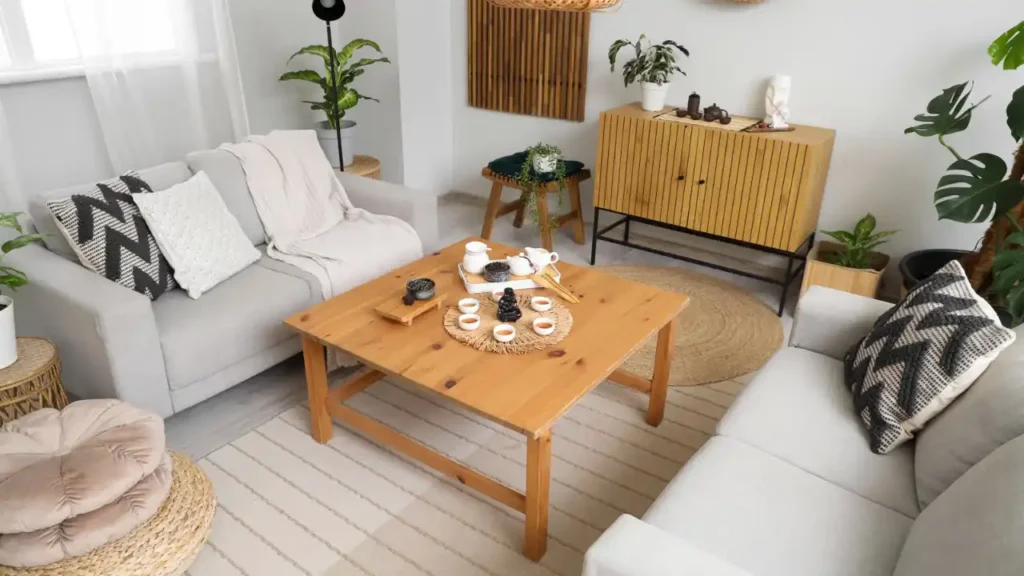
The key is to balance comfort, scale, function, and visual breathing room.
What Furniture Works Best in a Small Living Room?
The best furniture for a compact living room is not necessarily the smallest furniture available. A piece can be physically small but still be uncomfortable, impractical, or poorly suited to the room.
Look for furniture with these characteristics:
- Appropriate scale for the room
- Moderate or shallow depth
- Slim arms where possible
- Useful storage
- Multifunctional features when they solve a real need
- Easy movement around the room
- Flexible positioning
- A visually lighter profile
- Enough seating for the people who actually use the room
Small Living Room Furniture vs. Small Furniture
These terms are not always interchangeable.
A tiny loveseat might take up little space but fail to provide enough seating for a family. On the other hand, a large sectional may provide plenty of seating but consume too much floor area.
A medium-depth sofa with slim arms can sometimes provide a better balance between comfort and usable space.
Think about how much function you get from the footprint, rather than simply choosing the smallest dimensions.
Best Small Living Room Furniture Ideas
1. Compact Sofa With Slim Arms
A compact sofa is often the most important piece in a small living room because it typically occupies more floor space than anything else.
Look for a design with:
- Moderate depth
- Slim arms
- Comfortable seat proportions
- A width appropriate for the wall
- A streamlined silhouette
Slim arms can make a meaningful difference because they reduce the amount of width consumed by the sofa without necessarily reducing the number of seats.
A compact sofa works particularly well against a wall, beneath a window when height allows, or opposite a media console.
2. Small Sectional Sofa
A small sectional can be surprisingly practical when you need several seats but have limited floor space.
Consider:
- Apartment-size sectionals
- L-shaped designs
- Reversible chaise sectionals
- Compact corner sectionals
An L-shaped sectional can use a corner that might otherwise remain underutilized. A reversible chaise can also give you more flexibility if the room layout changes.
Before buying a sectional, check which side the chaise occupies and measure the complete footprint rather than relying only on the sofa’s advertised width.
For more inspiration, see our guide to Small Sectional Sofa Ideas.
3. Loveseat for Very Small Living Rooms
When space is extremely limited, a loveseat can provide comfortable two-person seating without dominating the room.
A loveseat works well with:
- One compact accent chair
- A small side table
- A storage ottoman
- A narrow coffee table
This arrangement can be particularly useful in apartments, studio spaces, and small TV rooms.
4. Apartment-Size Sofa
Apartment-size sofas are designed around tighter footprints, making them useful for compact rooms and buildings where furniture delivery can also be challenging.
Don’t look only at overall width. Check:
- Sofa depth
- Arm thickness
- Seat height
- Back height
- Leg design
- Delivery dimensions
A sofa that technically fits the room can still be difficult to use if its depth leaves little space for circulation.
5. Storage Ottoman
A storage ottoman can perform several jobs at once.
It can function as:
- A footrest
- Extra seating
- A casual table surface
- Blanket storage
- Toy storage
- A flexible piece that can move around the room
This makes it a useful example of multifunctional furniture.
If the ottoman will be used as a table, choose a stable surface or use a removable tray for drinks and accessories.
6. Lift-Top Coffee Table
A lift-top coffee table can provide both a surface and concealed storage.
Depending on the design, it can be used for:
- Remote controls
- Books
- Board games
- Small electronics
- Laptop use
- Casual meals
The important consideration is clearance. Make sure the tabletop can open without hitting the sofa, wall, lamp, or another piece of furniture.
7. Nesting Coffee Tables
Nesting tables give you flexible surface space without permanently occupying the footprint of several full-size tables.
Use the tables together when you need more surface area, then separate them when guests arrive or when you need an additional side table.
They work particularly well in rooms where flexibility matters more than having one large central coffee table.
8. Small Round Coffee Table
A small round coffee table can work well in a compact room because its curved shape eliminates sharp corners and can make movement around the table feel more natural.
Choose one that is proportional to the sofa and leaves enough room for comfortable circulation.
A round table is especially useful when the living room has multiple walking paths.
9. Slim Console Table
A narrow console table can provide useful surface space without requiring the depth of a conventional cabinet.
Place one:
- Behind a sofa
- Along a narrow wall
- Near an entry transition
- Behind a floating sofa in an open-plan room
Choose a design with drawers or shelves if you need additional storage.
10. Slim TV Console
A large media cabinet can overwhelm a small living room. A slim TV console provides a more proportional alternative.
Look for:
- Shallow depth
- Closed storage
- Cable-management features
- A width appropriate for the TV
- Low-profile construction
Avoid buying a large console simply because it offers more storage. If most of the capacity will remain unused, the additional bulk may not be worthwhile.
11. Wall-Mounted TV Cabinet
Floating or wall-mounted storage can free some visible floor area and create a cleaner appearance.
A wall-mounted cabinet can store:
- Gaming accessories
- Remotes
- Small electronics
- DVDs or media
- Household accessories
Before installation, check wall construction, mounting requirements, cable routing, and rental restrictions.
12. Compact Accent Chair
One well-chosen accent chair can add seating without requiring another full-size sofa.
Consider:
- Narrow-arm chairs
- Armless chairs
- Compact swivel chairs
- Lightweight-looking frames
Place the chair beside the sofa or at an angle to create a small conversation area.
Avoid adding multiple accent chairs simply because there is technically room for them.
13. Small Storage Bench
A storage bench can provide both seating and concealed storage.
It can work:
- Under a window
- Against a wall
- Near an open-plan transition
- Alongside a sofa
Use it for blankets, toys, games, or other items that need to be accessible but do not need to remain visible.
14. Floating Shelves
Floating shelves add vertical storage without consuming floor space.
Use them for:
- Books
- Framed photos
- Small plants
- Decorative objects
- Frequently used lightweight items
Avoid filling every shelf. Leaving some visible space helps prevent the wall from becoming visually crowded.
15. Narrow Bookcase
A narrow, tall bookcase can take advantage of vertical space when floor area is limited.
Compared with a wide bookcase, a vertical design can provide useful storage while occupying a smaller footprint.
Place it in:
- An unused corner
- Beside a sofa
- Near a desk
- Along a narrow wall
16. Storage Coffee Table
A storage coffee table provides another opportunity to combine everyday function with organization.
Options include:
- Drawers
- Open shelves
- Lift-top compartments
- Hidden storage
Choose the configuration according to what you actually need to store. A large compartment is not necessarily useful if your everyday items are small and frequently accessed.
17. Small Side Tables
Side tables should provide useful surface area without blocking circulation.
Look for a table that:
- Fits beside the sofa
- Allows easy access from the seat
- Does not block a walkway
- Has useful storage when needed
- Is proportionate to the sofa
A compact table with a drawer can sometimes replace a larger storage piece.
Small Living Room Furniture Ideas for Maximum Seating
Getting more seating into a small living room is primarily a question of efficiency and proportion.
Consider these combinations:
Compact Sectional + Ottoman
A small sectional provides multiple seats while the ottoman can serve as a footrest, occasional seat, or flexible table surface.
Sofa + Slim Accent Chair
This is a practical arrangement for narrow rooms where a second full-size seating piece would be excessive.
Loveseat + Two Lightweight Chairs
This setup can work well for conversation-focused rooms because the chairs can be repositioned when needed.
Sofa + Storage Bench
A storage bench provides additional seating without necessarily looking like another bulky chair.
Armless Chairs Around a Small Table
Armless seating can have a visually lighter profile, although comfort and available space should still determine the choice.
Reversible Chaise Sectional
A reversible chaise can provide lounging space while giving you more flexibility when the room arrangement changes.
Ottoman That Doubles as Seating
An appropriately sized ottoman can provide flexible seating when guests arrive without permanently adding another chair.
The goal is to maximize useful seating per square foot, not simply increase the number of furniture pieces.
Small Living Room Furniture Ideas With Storage
Storage furniture can reduce the need for separate cabinets and shelving.
Useful options include:
- Storage ottomans
- Storage benches
- Lift-top coffee tables
- Sofas with storage
- TV consoles with drawers
- Closed sideboards
- Floating cabinets
- Slim bookcases
- Storage consoles
What Should You Store in Each Piece?
| Furniture | Best For |
|---|---|
| Storage ottoman | Blankets, toys, accessories |
| Lift-top table | Remotes, books, electronics |
| TV console | Media devices, games, cables |
| Storage bench | Blankets, toys, seasonal items |
| Floating cabinet | Everyday household items |
| Slim bookcase | Books and decor |
For a broader look at efficient furniture for compact homes, explore Small Room Furniture Ideas.
Multifunctional Furniture for Small Living Rooms
Multifunctional furniture is valuable when one piece can replace two or more separate items.
Examples include:
- Ottoman + storage
- Coffee table + workspace
- Sofa bed + guest bed
- Bench + storage
- Console + desk
- Side table + cabinet
- Sectional + chaise
- Nesting tables + flexible surfaces
However, multifunctional does not automatically mean better.
A piece with ten features may be less useful than a simple piece that performs one or two jobs extremely well.
Choose multifunctional furniture when the additional function solves a real problem in your room.
Best Small Living Room Furniture Ideas for Apartments
Apartment living creates additional considerations beyond room size.
Good starting points include:
- Apartment-size sofas
- Compact sectionals
- Loveseats
- Nesting tables
- Storage ottomans
- Slim TV consoles
- Wall-mounted shelving where permitted
- Narrow consoles
- Lightweight accent chairs
Check the Building Before Buying
Measure:
- Entry doors
- Hallways
- Staircases
- Elevator doors
- Elevator interiors
- Tight turns
If you rent, also check whether wall-mounted furniture, shelving, or TV cabinets are permitted.
Furniture that fits the living room but cannot get through the building entrance is not a practical purchase.
Small Living Room Furniture Ideas for Different Layouts
Long Narrow Living Room
A long room benefits from furniture that preserves a clear path through the space.
Consider:
- Apartment-size sofa
- Narrow coffee table
- Slim console
- One compact accent chair
Avoid placing deep furniture along both sides of the room if it creates a tunnel-like walkway.
Square Small Living Room
A compact sectional can make efficient use of a corner.
Pair it with:
- A round coffee table
- Small side tables
- A compact storage piece
Open-Plan Small Living Room
Furniture can define the living zone without building a wall.
Consider:
- Compact sectional
- Low-profile sofa
- Slim console
- Open shelving
A sofa can act as a visual boundary between the living area and dining or kitchen space.
Living Room With a Fireplace
The fireplace may become the natural focal point.
Arrange furniture toward it while preserving a comfortable path through the room. Avoid forcing an oversized sofa into the space simply to fill a wall.
Smaller complementary pieces can create a more balanced arrangement.
Living Room With a Large Window
Keep the window visually and physically accessible.
Low-profile furniture can work particularly well in front of or near large windows, provided it does not block necessary access, natural light, ventilation, or window operation.
A storage bench can also make use of the area beneath a suitable window.
Small Living Room Furniture Layout Ideas
Layout 1: Sofa + Accent Chair
Best for: Narrow rooms and apartments.
A compact sofa provides the primary seating while a single chair adds another position without requiring a second sofa.
Layout 2: Compact Sectional + Ottoman
Best for: Families and flexible seating.
The sectional maximizes corner seating while the ottoman can move when floor space is needed.
Layout 3: Loveseat + Two Chairs
Best for: Conversation-focused rooms.
Position the chairs opposite or slightly angled toward the loveseat.
Layout 4: Sofa + Storage Ottoman
Best for: Minimalist rooms.
The ottoman can replace a conventional coffee table while adding storage and occasional seating.
Layout 5: Floating Sofa + Console
Best for: Open-plan spaces.
A slim console behind the sofa can create a visual boundary and provide a small amount of storage.
Layout 6: Sofa + Round Coffee Table
Best for: Rooms where circulation is tight.
The rounded shape can make movement around the central table more comfortable than a large rectangular design.
How to Arrange Furniture in a Small Living Room
A good layout begins before you start moving furniture.
Step 1: Measure the Room
Record:
- Width
- Length
- Ceiling height
- Doors
- Windows
- Radiators
- Outlets
- Permanent architectural features
Step 2: Identify the Main Focal Point
The focal point might be:
- TV
- Fireplace
- Window
- Outdoor view
- Architectural feature
Arrange the largest furniture around this feature rather than randomly filling available wall space.
Step 3: Choose the Largest Furniture First
Usually, the order is:
- Sofa or sectional
- Main table
- Accent seating
- Storage furniture
- Accessories
Step 4: Protect Walking Paths
A beautiful layout becomes frustrating if people have to squeeze between furniture.
Think about the routes people naturally take through the room and protect those paths.
Step 5: Add Smaller Pieces Last
Do not fill every empty corner immediately.
Once the essential furniture is placed, live with the arrangement for a while. You may discover that some empty space is actually useful.
How Much Furniture Should a Small Living Room Have?
There is no universal number of furniture pieces that every small living room should contain.
The right amount depends on:
- Room dimensions
- Number of people using the room
- Seating requirements
- Storage needs
- Traffic flow
- Furniture dimensions
- Existing architecture
- Lifestyle
A useful rule is simple:
Every furniture piece should have a clear purpose.
If a table, chair, cabinet, or decorative piece makes movement harder without providing meaningful function, reconsider whether it belongs in the room.
Furniture Size Guide for Small Living Rooms
Use this table as a starting point rather than a rigid measurement standard.
| Furniture | What to Look For |
|---|---|
| Sofa | Compact width + moderate depth |
| Sectional | Apartment-size or reversible |
| Loveseat | Two-person seating |
| Coffee table | Proportional to sofa |
| Accent chair | Slim profile |
| TV console | Shallow depth |
| Bookcase | Tall rather than wide |
| Ottoman | Dual-purpose |
| Console | Narrow depth |
| Side table | Small footprint |
The correct dimensions depend on your room, furniture arrangement, walking paths, and how each piece opens or moves.
How to Choose the Right Sofa for a Small Living Room
The sofa usually has the biggest influence on how a small living room feels.
Sofa Width
Measure the available space rather than assuming a standard sofa will fit.
Remember to account for side tables, doorways, windows, and circulation.
Sofa Depth
Depth is often overlooked.
A sofa that is only slightly narrower than another model can still consume significantly more floor space if it is much deeper.
Choose a depth that provides the comfort you want without unnecessarily reducing usable floor area.
Arm Width
Slim arms can provide more usable seating width within the same overall sofa footprint.
Seat Height
Seat height affects both comfort and visual proportion. Choose based on how the sofa will actually be used rather than choosing a low sofa simply because it looks modern.
Leg Style
Raised legs can expose more of the floor beneath the sofa, creating a lighter visual appearance.
Chaise Direction
If you choose a sectional with a fixed chaise, verify its direction before ordering.
A left-facing chaise that fits one room layout may become inconvenient if the furniture needs to be rearranged later.
Delivery Dimensions
Measure:
- Doorways
- Hallways
- Stairs
- Elevator
- Tight turns
For additional sofa inspiration, explore Compact Sectional Sofa for Small Spaces, Low Profile Modern Sofa, and Performance Fabric Sofa Ideas.
Small Living Room Furniture: Hidden vs. Open vs. Visible Storage
Storage does not have to look the same throughout the room.
| Storage Type | Visibility | Accessibility | Best Use |
|---|---|---|---|
| Open shelves | High | Very easy | Books and decor |
| Closed cabinets | Low | Easy | General organization |
| Hidden compartments | Very low | Varies | Everyday clutter |
| Storage ottomans | Low | Easy | Blankets and toys |
| Floating cabinets | Low | Easy | Compact-room storage |
A combination often works better than choosing only one type.
Open storage can display attractive objects and make frequently used items easy to reach. Closed storage can conceal everyday clutter. Hidden compartments can be useful when you want a particularly clean surface.
The important question is not which storage type is universally best, but which type fits the item and frequency of use.
For more concealed furniture solutions, see Hidden Storage Furniture Ideas.
Best Furniture Styles for Small Living Rooms
Several furniture styles can work well in compact rooms.
Modern
Modern furniture often uses clean lines and streamlined forms that can fit neatly into compact layouts.
Minimalist
Minimalist furniture focuses on fewer pieces and controlled visual clutter.
Scandinavian
Scandinavian-inspired furniture often combines practical forms, light finishes, and comfortable proportions.
Japandi
Japandi furniture can work well when you want simple forms, natural materials, and a calm visual environment.
Mid-Century Modern
Slim legs and relatively streamlined silhouettes can make mid-century modern furniture useful in smaller rooms.
Contemporary
Contemporary furniture offers a broad range of shapes and materials, making it possible to select pieces according to the room rather than a strict design formula.
No single furniture style is automatically best for every small living room. Scale and layout matter more than the style label.
Colors and Materials for Small Living Room Furniture
Furniture finishes influence how heavy or light a room feels visually.
Useful approaches include:
- Light wood
- Neutral upholstery
- Glass or visually light tables
- Coordinated wood tones
- Matte finishes
- Limited contrasting colors
However, this does not mean every small room needs white or pale furniture.
Dark furniture can work beautifully in a compact room when the piece is appropriately scaled and the overall layout provides enough visual breathing room.
The bigger issue is often visual weight, not color alone.
Avoid combining too many competing finishes, oversized dark furniture, and excessive decorative details if the room already feels crowded.
Small Living Room Furniture Mistakes to Avoid
1. Buying Before Measuring
Never rely on appearance alone.
2. Choosing Furniture Based Only on Width
Depth can be just as important.
3. Ignoring Furniture Depth
A deep sofa or cabinet can consume more usable space than expected.
4. Blocking Walking Paths
A room needs comfortable circulation.
5. Using an Oversized Sectional
More seating is not helpful if the sectional makes the rest of the room unusable.
6. Choosing an Oversized Coffee Table
The central table should work with the sofa and the available circulation space.
7. Adding Too Many Accent Chairs
Extra seating can quickly become visual and physical clutter.
8. Buying Storage Furniture With Little Usable Capacity
A cabinet with complicated compartments is not necessarily better than a simple, accessible storage piece.
9. Blocking Windows
Furniture should not unnecessarily block natural light, ventilation, or access.
10. Ignoring Door and Drawer Clearance
Measure the furniture in its fully open configuration.
11. Matching Furniture Only to the Wall
A piece can fit against a wall and still overwhelm the entire room.
12. Using Too Many Furniture Styles
A room with too many unrelated shapes and finishes can feel visually busy.
13. Filling Every Corner
Empty space is not automatically wasted space.
14. Forgetting Delivery Dimensions
Always consider how the furniture gets into the home.
15. Choosing Appearance Over Comfort
Furniture is meant to be used. A beautiful sofa that is uncomfortable for everyday use is not a successful choice.
How to Make a Small Living Room Look Bigger With Furniture
Furniture cannot physically enlarge the room, but the right choices can make the space feel more open.
Use Raised-Leg Furniture
Visible floor beneath furniture can create a lighter visual effect.
Keep Large Pieces Proportional
Avoid oversized furniture that dominates the room.
Choose Slim Arms
Slim arms can increase usable seating within a similar footprint.
Use Floating Storage
Wall-mounted cabinets and shelves can reduce the amount of visible floor furniture.
Keep Pathways Clear
An uninterrupted path can make the room feel easier to navigate.
Use Round or Nesting Tables
Flexible table arrangements can help preserve circulation.
Avoid Blocking Windows
Allow natural light and important sightlines to remain open where possible.
Maintain Breathing Room
Do not automatically fill every empty area.
Choose Fewer, Better-Proportioned Pieces
A small collection of useful furniture often works better than many undersized pieces.
Small Living Room Furniture on a Budget
A limited budget does not mean you have to sacrifice good space planning.
Spend More on:
- Sofa construction
- Frequently used seating
- Durable upholstery
- Drawer and hinge hardware
- Everyday furniture
Save on:
- Occasional side tables
- Decorative shelving
- Small accent pieces
- Temporary furniture
A useful strategy is to prioritize furniture that solves more than one problem.
For example, a storage ottoman can provide seating, foot support, storage, and a flexible surface. That may be more useful than buying four separate inexpensive pieces.
For more guidance, see High Quality Affordable Furniture.
Multifunctional vs. Compact Furniture
Compact furniture and multifunctional furniture solve related but different problems.
| Feature | Compact Furniture | Multifunctional Furniture |
|---|---|---|
| Primary goal | Save physical space | Perform multiple functions |
| Storage | Optional | Often included |
| Flexibility | Moderate | High |
| Best for | Tight footprints | Rooms needing versatility |
| Complexity | Usually lower | Can be higher |
| Example | Slim sofa | Storage ottoman |
The ideal piece may combine both characteristics.
For example, a compact storage ottoman takes up relatively little floor space while providing several functions.
Small Living Room Furniture Buying Framework
Use this process before purchasing any major piece.
1. Measure the Room
Record all important dimensions.
2. Identify Essential Functions
Decide whether you primarily need seating, storage, a work surface, entertainment storage, or a combination.
3. Decide Seating Requirements
Think about the number of people who regularly use the room.
4. Identify Storage Needs
Determine what actually needs to be stored before buying furniture with extra capacity.
5. Choose the Largest Furniture Piece
Usually this will be the sofa or sectional.
6. Check Furniture Depth
Do not focus only on width.
7. Plan Walking Paths
Make sure the room remains easy to move through.
8. Check Open-Door and Drawer Clearance
Storage furniture needs room to function.
9. Consider Visual Weight
Look at legs, upholstery, color, arm thickness, and overall silhouette.
10. Measure Delivery Access
Check doors, halls, stairs, elevators, and turns.
11. Match Existing Furniture
New furniture should work with what you already own unless you are furnishing the room from scratch.
12. Leave Some Empty Space
A room does not need to be completely filled to feel finished.
Five-Minute Small Living Room Furniture Test
Before buying a piece, ask yourself:
- What problem does this furniture solve?
- Does it fit the room dimensions?
- Is its depth appropriate?
- Can people move around it comfortably?
- Does it provide enough seating?
- Does it provide useful storage?
- Does it block a window, vent, or outlet?
- Can it fit through the doorway?
- Does it work with my existing furniture?
- Would a smaller or multifunctional piece solve the same problem?
If you cannot clearly answer why you need the furniture, reconsider the purchase.
Small Living Room Furniture Buying Checklist
- Did I measure the room?
- Did I measure the furniture?
- Did I check furniture depth?
- Did I measure doors and hallways?
- Did I check walking space?
- Does the furniture provide enough seating?
- Does it solve a specific need?
- Does it provide useful storage?
- Can drawers and doors open fully?
- Does it block windows or outlets?
- Does it fit the room’s visual scale?
- Does it coordinate with existing furniture?
- Is it comfortable enough for daily use?
- Can it be moved if the layout changes?
- Will I still have enough open space?
Small Living Room Furniture Ideas by Need
| Need | Furniture Solution |
|---|---|
| Maximum seating | Compact sectional |
| Two-person seating | Loveseat |
| Flexible seating | Storage ottoman |
| Hidden storage | Lift-top table |
| Display storage | Floating shelves |
| Media storage | Slim TV console |
| Extra seating | Storage bench |
| Flexible surfaces | Nesting tables |
| Narrow wall storage | Tall bookcase |
| Open-plan zoning | Compact sofa + console |
| Small apartment | Apartment-size sofa |
| Minimalist look | Low-profile streamlined furniture |
Best Small Living Room Furniture Ideas by Room Shape
| Room Shape | Furniture Approach |
|---|---|
| Long and narrow | Sofa + slim tables |
| Square | Compact sectional or sofa + chairs |
| Open plan | Sectional or floating sofa |
| Corner living room | L-shaped sectional |
| Window-focused | Low-profile seating |
| Fireplace-focused | Conversation-oriented seating |
| Very small | Loveseat + multifunctional furniture |
Frequently Asked Questions — Small Living Room Furniture Ideas
What furniture is best for a very small living room?
Compact sofas, loveseats, storage ottomans, nesting tables, and slim storage furniture are useful starting points. The best choice depends on the room’s dimensions, seating requirements, and circulation.
Is a sectional good for a small living room?
Yes, an appropriately scaled sectional can work well. Apartment-size and reversible chaise sectionals can provide multiple seats while using a corner efficiently. An oversized standard sectional, however, may overwhelm the room.
What sofa size is best for a small living room?
There is no single sofa size that works for every room. Consider overall width, depth, arm width, seating capacity, and the amount of space needed for circulation.
How can I fit more seating into a small living room?
Use compact sectionals, loveseats, slim accent chairs, storage benches, and multifunctional ottomans. Focus on useful seating capacity rather than simply adding more furniture.
Should a small living room have a coffee table?
Not necessarily. A small round table, nesting tables, C-table, or storage ottoman can be a better fit depending on the room layout.
How do I add storage without making my living room feel crowded?
Use furniture that combines storage with an existing function. Storage ottomans, lift-top coffee tables, slim TV consoles, floating cabinets, and storage benches can provide organization without requiring several separate cabinets.
Is a storage ottoman useful in a small living room?
It can be especially useful because one piece can provide seating, foot support, storage, and sometimes a surface for a tray. Choose one that is appropriately sized for the room.
Are dark furniture colors bad for small living rooms?
No. Dark furniture can work in a small living room. Scale, proportion, lighting, furniture depth, and overall visual weight are usually more important than color alone.
How do I make a small living room look bigger with furniture?
Use appropriately scaled pieces, preserve walking paths, consider raised-leg furniture, avoid blocking windows, use floating storage where practical, and avoid filling every available corner.
What furniture should I avoid in a small living room?
Avoid furniture that is excessively deep, oversized, difficult to move around, poorly proportioned, or equipped with features you do not actually need. The problem is usually poor fit rather than a particular furniture category.
Final Thoughts
A successful small living room is not created by buying the smallest furniture available. It comes from choosing pieces that provide the right combination of comfort, scale, function, storage, and flexibility.
Measure before buying. Prioritize the sofa. Pay attention to depth, not just width. Choose multifunctional pieces when they solve a genuine problem, and use vertical or floating storage when it helps preserve floor space.
Most importantly, do not feel pressured to fill every corner.
A small living room can feel comfortable and complete when the furniture has enough room to perform its purpose and people have enough room to move around it.
The best small living room furniture ideas are not about fitting more furniture into less space. They are about choosing fewer, better-proportioned pieces that make the room more comfortable, functional, and visually balanced.
