
Choosing furniture for your home is about more than finding the right color, size, and style. The materials you choose, how long a piece lasts, whether it can be repaired, and what happens to it when you no longer need it can all influence how thoughtfully you furnish your space.
That is why eco friendly furniture ideas are becoming increasingly useful for homeowners, renters, and anyone who wants a more sustainable approach to interior design.
Eco-friendly furniture does not have to look rustic, unfinished, or overly earthy. Reclaimed wood can look sophisticated, recycled metal can complement modern interiors, vintage furniture can work beautifully with contemporary pieces, and natural fabrics can add softness to minimalist rooms.
The key is to look beyond broad labels. Instead of assuming that one material is automatically sustainable, consider its sourcing, manufacturing, durability, repairability, certifications, and expected lifespan.
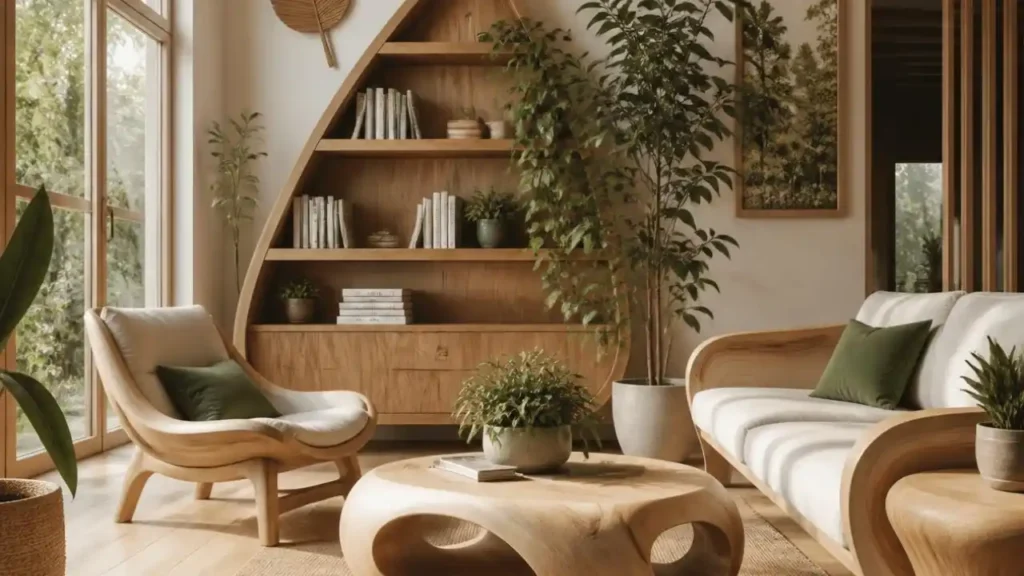
In this guide, you’ll find 25 eco-friendly furniture ideas, sustainable material options, budget-friendly strategies, small-space solutions, buying tips, and practical ways to recognize vague environmental claims.
What Does Eco-Friendly Furniture Actually Mean?
Eco-friendly furniture is a broad term used to describe furniture designed, manufactured, sourced, or used in ways that may reduce environmental impact compared with less responsible alternatives.
There is no single material or construction method that automatically makes every piece of furniture eco-friendly.
A better approach is to evaluate the entire product.
Sustainable or Responsibly Sourced Materials
Materials commonly associated with more responsible furniture choices include:
- Reclaimed wood
- FSC-certified wood
- Bamboo
- Cork
- Recycled metal
- Recycled plastics
- Recycled fibers
- Responsibly sourced natural textiles
However, the material itself is only part of the story. Consider where it came from, how it was processed, how much material was used, and whether the finished furniture is built to last.
Durability and Longevity
A durable piece can remain useful for many years instead of being replaced frequently.
Look for furniture with:
- Strong joints
- Durable surfaces
- Replaceable hardware
- Repairable components
- Quality upholstery
- Refinishable wood
- Timeless designs
Longevity matters because furniture that remains useful for longer does not need to be replaced as often.
Responsible Manufacturing
Manufacturing can also affect the overall environmental profile of furniture.
When information is available, consider:
- Where materials are sourced
- Where furniture is manufactured
- How production waste is handled
- Packaging materials
- Shipping considerations
- Manufacturer transparency
A company that clearly explains its materials and manufacturing process gives shoppers more useful information than one that simply uses words such as “green” or “eco.”
End-of-Life Considerations
Think about what happens when the furniture is no longer needed.
A well-designed piece may be:
- Repaired
- Refinished
- Reupholstered
- Resold
- Donated
- Repurposed
- Recycled
- Disassembled for parts
This broader perspective makes sustainability a practical furniture decision rather than simply a marketing label.
What’s the Difference Between Eco-Friendly, Sustainable, Recycled, and Reclaimed Furniture?
These terms are often used interchangeably, but they do not mean exactly the same thing.
| Furniture Type | What It Means | Potential Benefit | What to Check |
|---|---|---|---|
| Eco-friendly | Broad environmental claim | May indicate reduced environmental impact | Look for specific evidence |
| Sustainable | Broad approach to responsible resource use | Can support longer-term resource management | Sourcing and documentation |
| Reclaimed | Previously used material recovered for another use | Extends the useful life of existing material | Previous use and treatment |
| Recycled | Material processed into a new material or product | Can reduce reliance on virgin material | Recycled content |
| Secondhand | Previously owned furniture | Keeps an existing product in use | Condition and repairability |
| Vintage | Older furniture reused in a new setting | Extends the life of existing furniture | Construction and condition |
The important point is that none of these labels should automatically end the evaluation.
For example, reclaimed wood may be an excellent choice, but buyers should still ask how it was treated and whether it is suitable for the intended application.
Likewise, expensive furniture is not automatically sustainable, and inexpensive furniture is not automatically wasteful. Product quality, useful lifespan, repairability, sourcing, and actual use all matter.
25 Eco Friendly Furniture Ideas for a Stylish Home
The best sustainable furniture choices can work with almost any decorating style. Here are 25 practical ideas to consider when furnishing your home.
1. Reclaimed Wood Dining Tables
A reclaimed wood dining table can bring warmth, texture, and character into a dining room while giving previously used wood another purpose.
The natural variation in reclaimed boards can make each table visually distinctive. Depending on the finish and base, the same material can work in rustic, industrial, farmhouse, contemporary, or modern interiors.
When shopping, ask where the wood came from and whether it has been properly prepared for furniture use.
Best for: Dining rooms, open-plan spaces, farmhouse interiors, modern rustic homes.
Styling idea: Pair a reclaimed wood tabletop with streamlined black or brushed-metal chairs for a modern contrast.
2. FSC-Certified Wood Coffee Tables
Wood furniture can be a beautiful and durable option, but responsible sourcing matters.
Furniture made with appropriately certified wood can give shoppers additional information about the source and management of the material.
When looking at certification claims, check the actual product documentation rather than assuming every wood product is certified.
A simple solid-wood coffee table can also remain useful through multiple decorating changes.
Best for: Living rooms, family rooms, apartments.
Styling idea: Choose a simple wood table and combine it with a modern sofa, wool rug, and ceramic accessories.
3. Reclaimed Wood Console Tables
A reclaimed wood console table can introduce sustainable character without taking up much floor space.
Use one in:
- Entryways
- Hallways
- Living rooms
- Behind sofas
- Dining areas
Look for sturdy construction and a finish appropriate for the location.
Styling idea: Keep the surface relatively simple with a table lamp, mirror, small plant, and one or two decorative objects.
4. Bamboo Furniture
Bamboo is a popular material for furniture because it grows quickly and can be manufactured into a variety of products.
It can appear in:
- Shelving
- Chairs
- Tables
- Cabinets
- Benches
- Bed frames
However, “bamboo” alone does not tell you everything about a product’s environmental impact. Consider the source, manufacturing process, adhesives, finish, transportation, and durability.
Best for: Minimalist, contemporary, Scandinavian, and natural interiors.
Styling idea: Combine light bamboo with warm whites, soft beige, linen, and simple black accents.
5. Recycled Metal Furniture
Recycled metal can be used for table frames, shelving, chairs, bed frames, and storage furniture.
Metal can also offer excellent structural durability when properly designed.
Look for manufacturers that provide information about recycled content rather than relying only on general sustainability language.
Best for: Industrial, modern, minimalist, and contemporary interiors.
Styling idea: Combine a recycled-metal frame with reclaimed wood for a balanced industrial-modern look.
6. Secondhand Solid-Wood Furniture
Buying secondhand furniture can give an existing product another useful life.
Potential sources include:
- Thrift stores
- Estate sales
- Vintage stores
- Local marketplaces
- Consignment shops
- Community resale groups
Solid-wood furniture can be especially interesting because many pieces can be repaired, refinished, or updated.
Before buying, inspect joints, drawers, surfaces, hardware, and signs of damage.
Best for: Almost any room or decorating style.
7. Vintage Dressers
A vintage dresser can become a practical and stylish alternative to buying a new storage unit.
You can update the appearance by:
- Refinishing the wood
- Replacing hardware
- Repairing drawers
- Cleaning the existing finish
- Adding new drawer pulls
Avoid unnecessary refinishing when the existing surface is already attractive and functional.
Styling idea: Pair a vintage dresser with contemporary artwork and modern lighting to create a collected look.
8. Reclaimed Wood Shelving
Reclaimed wood shelves can bring warmth to kitchens, offices, bedrooms, and living rooms.
Open shelving can also be useful in small homes because it provides storage without visually filling the entire room with large cabinets.
Check the wood carefully for structural condition, previous treatments, and suitability for indoor use.
Best for: Kitchens, offices, living rooms, bedrooms.
9. Natural-Fiber Accent Chairs
Accent chairs upholstered with materials such as linen, wool, hemp, or cotton can add texture and comfort.
But a natural fiber is not automatically an environmentally superior choice. Consider:
- Fiber sourcing
- Manufacturing
- Durability
- Cleaning requirements
- Upholstery construction
- Replacement options
A durable chair that remains comfortable and useful for years may be more practical than one that needs frequent replacement.
Best for: Living rooms, bedrooms, reading corners, home offices.
10. Durable Wool-Upholstered Furniture
Wool can provide warmth, texture, and durability when used appropriately in upholstery.
A wool-upholstered chair or sofa can work particularly well in homes that favor natural textures.
Look beyond the fiber itself and investigate the furniture’s construction, fabric specifications, sourcing, and maintenance requirements.
Styling idea: Use wool upholstery with wood furniture and simple neutral textiles for an organic-modern room.
11. Modular Sofas Designed for Long-Term Use
Modular sofas can be useful because their configuration can change as your needs change.
For example, individual sections may be rearranged when:
- You move
- Your room layout changes
- You need additional seating
- You want a different lounging configuration
Some modular systems also offer replaceable covers or components.
When shopping, check whether replacement parts are available and how easily the sofa can be repaired.
12. Furniture With Replaceable Covers
Replaceable covers can be particularly useful for high-use furniture.
They can make it easier to refresh a piece without replacing the entire frame.
This can be helpful for:
- Families
- Pet owners
- Busy living rooms
- Rental homes
- Frequently changing interiors
Check whether the manufacturer actually sells replacement covers and whether they are expected to remain available.
13. Repairable Wooden Chairs
Well-constructed wooden chairs can often be repaired instead of discarded.
Look for:
- Strong joints
- Replaceable hardware
- Accessible construction
- Durable wood
- Repair-friendly designs
Traditional joinery can sometimes make furniture easier to maintain over time, although construction quality varies widely.
A chair that can be tightened, repaired, refinished, or reupholstered can remain useful far longer than a piece designed to be replaced.
14. Solid-Wood Bed Frames
A solid-wood bed frame can be a durable foundation for a bedroom.
When shopping, pay attention to:
- Frame construction
- Joint strength
- Slat design
- Hardware
- Finish
- Replacement parts
Choose a design that works with your room rather than following a short-lived trend.
Styling idea: Pair a simple wood bed with linen bedding, neutral colors, and natural-texture accessories.
15. Reclaimed Wood Nightstands
You do not need to furnish an entire home with reclaimed wood to introduce more sustainable materials.
A reclaimed wood nightstand can add character to a bedroom without overwhelming the space.
Look for designs with useful storage and sturdy construction.
A small piece can also be a practical way to experiment with reclaimed materials before investing in larger furniture.
16. Cork Furniture
Cork can be used for stools, side tables, seating, and decorative furniture components.
Its distinctive texture works particularly well in organic-modern and minimalist spaces.
When evaluating cork furniture, consider how the cork is processed, how the piece is constructed, and how durable it is for the intended use.
Styling idea: Combine cork with pale wood, linen, ceramic pieces, and muted colors.
17. Recycled Plastic Outdoor Furniture
Outdoor furniture made with recycled plastic can be useful when you need pieces that can handle changing weather conditions.
Look for information about:
- Recycled content
- Weather resistance
- UV performance
- Hardware
- Maintenance
- End-of-life options
Outdoor furniture should be selected based on actual climate and usage requirements rather than sustainability claims alone.
18. Sustainable Entryway Benches
An entryway bench can combine seating and storage in a single piece.
Look for:
- Durable wood
- Responsible sourcing
- Repairable construction
- Useful storage
- Long-lasting hardware
A multifunctional piece can be especially valuable in smaller homes because it serves more than one purpose.
19. Upcycled Furniture
Upcycling involves transforming an existing object or piece of furniture into something useful again.
Examples include:
- Converting an old cabinet into a bathroom vanity
- Turning a vintage table into a desk
- Reworking an old dresser
- Repurposing architectural wood
- Updating an outdated storage cabinet
The advantage is that you start with something that already exists.
Styling idea: Let the original character remain visible instead of making every upcycled piece look brand new.
20. Refurbished Furniture
Refurbished furniture sits somewhere between secondhand and renewed furniture.
A piece may be:
- Cleaned
- Repaired
- Refinished
- Reupholstered
- Reassembled
- Updated with new hardware
The goal is to restore useful life rather than simply discard the original product.
When buying refurbished furniture, ask what work was actually completed.
21. Secondhand Dining Chairs
Dining chairs are another easy category for secondhand shopping.
Because chairs are often available individually or in sets, you can search for specific shapes and materials without buying an entirely new dining set.
Check:
- Frame stability
- Seat condition
- Hardware
- Upholstery
- Structural damage
Mixing different secondhand chairs can also create an intentionally collected dining space.
22. Eco-Friendly Home Office Desks
A home office desk should be chosen for daily usability and longevity.
Consider:
- Solid or durable wood
- Reclaimed materials
- Repairable construction
- Durable finishes
- Useful cable management
- Appropriate dimensions
A good desk should fit both your room and your work habits.
For smaller rooms, a compact desk that can later move into another room may be more useful than a highly specialized workstation.
23. Sustainable Storage Cabinets
Storage furniture is often overlooked when discussing sustainable design.
Look for cabinets with:
- Durable construction
- Quality hinges
- Replaceable hardware
- Responsible material sourcing
- Long-lasting finishes
- Practical dimensions
Avoid buying oversized storage simply because it looks impressive. The most useful cabinet is one that solves a genuine storage problem and remains appropriate for the space.
24. Natural Wood Furniture With Thoughtful Finishes
Natural wood furniture can bring warmth and texture into almost any interior.
But avoid assuming that a finish is automatically environmentally friendly simply because it sounds natural.
When relevant, investigate:
- Finish ingredients
- VOC-related information
- Manufacturer documentation
- Maintenance requirements
- Durability
A durable finish can also help protect furniture from damage and extend its useful life.
25. Timeless Furniture Designed to Last
One of the simplest eco-friendly furniture ideas is to choose pieces you expect to use for a long time.
Instead of asking only:
“Is this furniture trendy?”
also ask:
“Will this still work for me several years from now?”
Timeless furniture does not have to be boring. It can have distinctive proportions, beautiful materials, interesting craftsmanship, or a strong silhouette without depending entirely on a short-lived trend.
Buying fewer, better-suited pieces can sometimes be more practical than repeatedly replacing inexpensive furniture.
Eco Friendly Furniture Ideas for Every Room
Sustainable furniture can work throughout the home.
Living Room
Consider:
- Reclaimed wood coffee tables
- Secondhand sofas
- Modular seating
- Vintage side tables
- Durable shelving
- Repairable accent chairs
Mixing old and new pieces can create a layered room without requiring an entirely new furniture collection.
Bedroom
Good options include:
- Solid-wood bed frames
- Vintage dressers
- Bamboo nightstands
- Secondhand benches
- Natural-fiber seating
Prioritize furniture that can remain useful through changes in bedding, wall colors, and decorative styles.
Dining Room
Consider:
- Reclaimed dining tables
- Secondhand dining chairs
- Solid-wood furniture
- Vintage dining sets
- Recycled-material tables
A well-built dining table can often become a long-term part of a home because it does not need to match every other piece perfectly.
Home Office
Useful choices include:
- Reclaimed desks
- Durable office chairs
- Wooden shelving
- Secondhand storage cabinets
- Repairable desk accessories
Measure carefully before buying, especially in smaller rooms.
Entryway
Consider:
- Reclaimed benches
- Vintage consoles
- Sustainable storage cabinets
- Wooden coat racks
- Secondhand furniture
The entryway is a particularly good place for refurbished furniture because small imperfections may add character rather than detract from the design.
Outdoor Spaces
Options include:
- Recycled-plastic furniture
- Responsibly sourced wood
- Durable metal furniture
- Repairable outdoor seating
Outdoor furniture should be selected according to your climate and maintenance requirements.
Eco Friendly Furniture Ideas for Different Design Styles
Sustainable furniture does not require one particular aesthetic.
Modern
Use:
- Clean-lined reclaimed wood
- Recycled metal
- Simple storage
- Modular sofas
- Minimal furniture
Combine natural materials with crisp silhouettes for a contemporary look.
Scandinavian
Scandinavian-inspired rooms can work well with:
- Light wood
- Simple furniture
- Natural textiles
- Functional storage
- Soft neutral colors
Keep the room uncluttered and emphasize functionality.
Japandi
For a Japandi-inspired room, consider:
- Natural wood
- Low-profile furniture
- Simple silhouettes
- Neutral colors
- Minimal decoration
The emphasis should be on calm functionality rather than excessive accessories.
Industrial
Industrial interiors naturally accommodate:
- Reclaimed wood
- Recycled metal
- Vintage furniture
- Exposed construction
- Dark hardware
Balance harder materials with textiles and softer lighting.
Organic Modern
Use a combination of:
- Wood
- Linen
- Wool
- Cork
- Stone
- Soft curves
This approach allows sustainable materials to feel refined rather than rustic.
Traditional
Consider:
- Vintage furniture
- Solid wood
- Heirloom pieces
- Repairable construction
- Refinished furniture
Traditional rooms are particularly well suited to furniture that shows craftsmanship and age.
Minimalist
A sustainable minimalist room can focus on:
- Fewer furniture pieces
- Multifunctional designs
- Durable construction
- Timeless silhouettes
- Practical storage
The goal is not simply to own less, but to make every piece useful.
Sustainable Furniture Materials to Look For
Different materials offer different characteristics, so compare them based on the product and its intended use.
| Material | Common Uses | What to Consider |
|---|---|---|
| Reclaimed wood | Tables, shelves, cabinets | Source and previous treatment |
| FSC-certified wood | Tables, chairs, cabinets | Verify certification |
| Bamboo | Tables, chairs, shelving | Manufacturing and sourcing |
| Recycled metal | Frames, tables, shelving | Recycled content |
| Cork | Stools, tables, accents | Construction and durability |
| Recycled plastic | Outdoor furniture | Recycled content and weather performance |
| Wool | Upholstery | Fiber sourcing and certifications |
| Linen | Upholstery and textiles | Processing and durability |
| Hemp | Textiles and upholstery | Fiber sourcing and processing |
There is no universal “best” material.
The better choice depends on how the material was sourced, how the furniture was manufactured, how long it will remain useful, and what happens when the product reaches the end of its life.
How to Tell If Furniture Is Actually Eco-Friendly
Sustainability claims can be difficult to evaluate because terms such as “green,” “natural,” and “conscious” can be broad.
A more useful approach is to ask specific questions.
Check the Material Source
Ask:
- Where did the material come from?
- Is it reclaimed, recycled, certified, or newly sourced?
- Does the manufacturer provide documentation?
- Is the claim specific?
A detailed material description is more useful than a vague environmental statement.
Look for Relevant Certifications
Depending on the product, you may encounter certifications such as FSC, GREENGUARD Gold, GOTS, or OEKO-TEX.
These certifications address different characteristics and should not be treated as interchangeable.
Before relying on a certification, understand what it actually evaluates.
Check Construction Quality
Inspect:
- Joints
- Hardware
- Frames
- Drawer construction
- Upholstery
- Surface finishes
- Replaceable components
A sustainable material does not compensate for furniture that breaks quickly.
Ask About Finishes and Adhesives
For certain furniture categories, you may want information about:
- Finishes
- Adhesives
- Formaldehyde-related emissions
- VOC-related certifications
- Product testing
Avoid assuming that a product is “chemical-free.” Almost all manufactured furniture involves materials and substances that should be evaluated specifically rather than described with absolute claims.
Look for Manufacturer Transparency
Useful information includes:
- Material sourcing
- Manufacturing location
- Certifications
- Product specifications
- Warranty
- Repair services
- Replacement parts
The more specific the information, the easier it is to make an informed comparison.
Eco-Friendly Furniture Buying Checklist
Before buying a piece of furniture, ask:
- Is it durable enough for its intended use?
- What material is it made from?
- Where was the material sourced?
- Is recycled or reclaimed content documented?
- Does it have a relevant certification?
- Can damaged parts be repaired?
- Are replacement parts available?
- Is there a warranty?
- Is the design likely to remain useful?
- Can the furniture be resold or reused?
- Is the environmental claim specific and verifiable?
This checklist can help prevent sustainability from becoming nothing more than a marketing label.
Eco Friendly Furniture Ideas for Small Apartments
Small homes can benefit from sustainable furniture because buying flexible pieces may reduce the need to replace furniture when you move or rearrange your space.
Consider:
- Multifunctional furniture
- Storage benches
- Extendable dining tables
- Modular sofas
- Compact desks
- Wall-mounted furniture
- Secondhand pieces
- Compact solid-wood furniture
A particularly useful strategy is to choose furniture that can perform more than one function.
For example, an entryway bench with storage can provide seating and organization, while an extendable dining table can serve everyday meals and larger gatherings.
Measure Before You Buy
For apartment furniture, measure:
- Available floor space
- Doorway width
- Hallway clearance
- Stairway dimensions
- Elevator dimensions
- Furniture footprint
- Required clearance around the piece
A beautiful sustainable table is not a practical purchase if it cannot get through the front door.
How to Create an Eco-Friendly Home on a Budget
Sustainable furnishing does not necessarily require buying expensive designer furniture.
Buy Secondhand
Start with:
- Thrift stores
- Estate sales
- Consignment stores
- Vintage shops
- Local marketplaces
Secondhand furniture can be particularly attractive when you are willing to inspect, clean, repair, or refinish pieces.
Repair What You Already Own
Before replacing furniture, ask whether it can be repaired.
Possible improvements include:
- Refinishing a table
- Replacing hardware
- Repairing loose joints
- Reupholstering a chair
- Replacing damaged components
Sometimes the most sustainable furniture purchase is the one you postpone because the existing piece can still be repaired.
Buy Fewer Pieces
A low purchase price is not necessarily the same as low long-term cost.
If inexpensive furniture needs to be replaced repeatedly, the total spending and material use can increase.
Consider how often you expect to use a piece and how long you realistically want it to last.
Prioritize High-Use Furniture
If your budget is limited, pay particular attention to furniture you use every day, such as:
- Sofas
- Beds
- Dining tables
- Desks
- Everyday chairs
A durable, comfortable piece is usually more important than an occasional decorative item.
Is Eco-Friendly Furniture More Expensive?
Sometimes it can be, but there is no universal relationship between price and sustainability.
| Factor | Lower-Cost Furniture | Durable/Thoughtful Furniture |
|---|---|---|
| Initial price | Often lower | Can be higher |
| Expected lifespan | Varies | Depends on construction |
| Repairability | May be limited | May be better |
| Materials | Varies | May offer more sourcing information |
| Resale potential | Varies | Depends on quality and design |
| Long-term value | Depends on replacement rate | Depends on durability and actual use |
A high price does not automatically mean a product is environmentally responsible.
Likewise, affordable furniture can be a thoughtful choice if it is durable, repairable, well-suited to your needs, or purchased secondhand.
How to Make Sustainable Furniture Look Modern
Some people imagine sustainable furniture as rustic, farmhouse-style pieces. That is only one possibility.
Mix Reclaimed Wood With Modern Materials
Try combining:
- Reclaimed wood
- Metal
- Glass
- Stone
- Neutral upholstery
A weathered wood table can look surprisingly contemporary when paired with clean-lined seating and modern lighting.
Use a Restrained Color Palette
Try:
- Warm white
- Beige
- Taupe
- Soft gray
- Natural wood
- Olive
- Charcoal
Neutral colors allow interesting materials and textures to become the focus.
Mix Old and New
For example, combine:
- A vintage dresser
- Modern sofa
- Contemporary lighting
- Reclaimed coffee table
This creates visual variety without requiring every item to come from the same collection.
Use Texture Instead of Excessive Decoration
Bring depth into the room with:
- Linen
- Wool
- Wood grain
- Woven textiles
- Cork
- Natural fibers
This can make sustainable interiors feel sophisticated and layered.
Mistakes to Avoid When Buying Sustainable Furniture
Mistake 1: Believing Every “Green” Label
A broad environmental claim does not tell you exactly what makes the furniture more sustainable.
Look for specific evidence.
Mistake 2: Assuming Natural Automatically Means Sustainable
Natural materials can still require land, water, processing, transportation, energy, and other resources.
“Natural” and “sustainable” are not interchangeable.
Mistake 3: Ignoring Durability
A furniture piece made from an appealing material may not be a thoughtful choice if it breaks or becomes unusable quickly.
Mistake 4: Ignoring Repairability
Before purchasing, check whether hardware, covers, cushions, or other components can be replaced.
Mistake 5: Buying More Furniture Than You Need
Sustainability can also involve consuming more intentionally.
Buy furniture because it solves a genuine need rather than because a trend makes it temporarily appealing.
Mistake 6: Choosing Furniture Based Only on Price
Price is one factor, not the complete measure of value.
Consider expected use, durability, maintenance, repairability, and lifespan.
Mistake 7: Ignoring Shipping and Packaging
For online purchases, look at packaging and delivery information when it is available.
Avoid making precise environmental comparisons unless reliable product-level information supports them.
Which Eco-Friendly Furniture Option Should You Choose?
There is no single choice that works for every home.
Instead, match the option to your priorities.
| If Your Priority Is… | Consider… |
|---|---|
| Reusing existing materials | Reclaimed furniture |
| Giving existing furniture another life | Secondhand furniture |
| Using recovered materials | Recycled-content furniture |
| Long-term durability | Well-built furniture |
| Responsible forestry | Appropriately certified wood |
| Small budget | Secondhand or refurbished furniture |
| Flexible layouts | Modular furniture |
| Custom appearance | Refinished or upcycled furniture |
This approach is more useful than declaring one material or furniture category universally superior.
How to Avoid Greenwashing When Buying Furniture
Greenwashing can make sustainability claims difficult to evaluate.
Be cautious when a product relies heavily on vague terms such as:
- “Green”
- “Eco”
- “Earth-friendly”
- “Natural”
- “Sustainable”
- “Conscious”
Instead, ask:
What specifically makes this product more environmentally responsible?
Look for:
- Specific material information
- Relevant certifications
- Recycled or reclaimed content
- Manufacturing details
- Warranty information
- Repair programs
- Replacement parts
- Supply-chain information
The more precise the claim, the easier it is to evaluate.
Eco Friendly Furniture Ideas at a Glance
| Furniture Idea | Best Room | Sustainability Angle | Style |
|---|---|---|---|
| Reclaimed wood table | Dining room | Reused material | Rustic/modern |
| Certified wood table | Dining room | Responsible sourcing | Modern |
| Bamboo shelving | Living room | Renewable material consideration | Minimalist |
| Vintage dresser | Bedroom | Existing furniture reuse | Traditional |
| Recycled metal table | Office | Recycled material | Industrial |
| Modular sofa | Living room | Adaptability and repair potential | Modern |
| Secondhand chairs | Dining room | Extends product life | Any |
| Cork stool | Kitchen | Cork material | Organic modern |
| Recycled outdoor furniture | Patio | Recycled content | Contemporary |
| Upcycled cabinet | Entryway | Reuses existing furniture | Eclectic |
FAQs About Eco Friendly Furniture Ideas
What is the most eco-friendly type of furniture?
There is no single universally most eco-friendly type of furniture. A thoughtful choice depends on factors such as material sourcing, manufacturing, durability, repairability, transportation, actual use, and end-of-life options.
A durable secondhand table may be a very different environmental choice from a newly manufactured table, even if both use attractive natural materials.
Is reclaimed wood furniture eco-friendly?
Reclaimed wood can be a thoughtful option because it gives existing material another use. However, the environmental benefits depend on factors such as the wood’s previous use, treatment, processing, transportation, and the durability of the finished furniture.
Is bamboo furniture sustainable?
Bamboo can be a useful furniture material because it is a rapidly growing plant, but the finished product should still be evaluated based on sourcing, processing, adhesives, transportation, durability, and manufacturing.
Is secondhand furniture more eco-friendly?
Secondhand furniture can extend the useful life of an existing product and avoid the need to manufacture a replacement immediately. However, condition, transportation, refurbishment, and expected lifespan still matter.
What furniture materials are best for sustainable homes?
Options worth investigating include reclaimed wood, appropriately certified wood, bamboo, cork, recycled metal, recycled materials, and responsibly sourced natural fibers.
Rather than choosing based solely on the material name, evaluate the specific product and how it is made.
Is expensive furniture more sustainable?
Not necessarily.
Price does not automatically indicate sustainability. Look at construction quality, material sourcing, durability, repairability, certifications, warranty, and expected lifespan.
How can I make my existing furniture more sustainable?
Start by keeping useful furniture in service.
You can:
- Repair loose joints
- Refinish suitable wood
- Replace hardware
- Reupholster chairs
- Replace damaged components
- Repurpose furniture
- Donate or resell pieces you no longer need
How do I know if furniture is really sustainable?
Look for specific information rather than broad claims.
Check material sourcing, relevant certifications, recycled or reclaimed content, construction quality, manufacturer transparency, warranty information, repair options, and replacement parts.
Final Thoughts
Creating a more eco-conscious home does not mean replacing every piece of furniture with something marketed as “sustainable.”
In many cases, a better approach is to buy more thoughtfully, keep useful furniture for longer, repair what you already own, consider secondhand options, and investigate the materials and claims behind new purchases.
The best eco friendly furniture ideas combine environmental consideration with practical requirements such as comfort, durability, style, budget, and room size.
Reclaimed wood, certified wood, bamboo, recycled materials, vintage furniture, refurbished pieces, modular designs, and durable natural textiles can all have a place in a thoughtful home. But none should be treated as automatically perfect.
Before buying, ask where the material came from, how the furniture was made, how long it is likely to last, whether it can be repaired, and what could happen to it when you no longer need it.
That mindset can help you create a home that feels beautiful today while making more considered furniture choices for the years ahead.
